

Insight

In an era of shifting economic landscapes and the rise of the digital economy, the quest for financial resilience has become increasingly important. Relying on a single source of revenue, typically a traditional salary, may limit long-term financial flexibility. Exploring alternative income streams can help support a more diversified approach to earnings.
This guide will help you explore 25 passive income strategies that can support your cash flow, grounded in the latest market trends for 2026.
Passive income is the strategic allocation of capital or time into assets that generate recurring revenue with minimal intervention. Unlike “get-rich-quick” narratives, it requires an upfront investment to build systems that eventually decouple earnings from active labor.
From a regulatory perspective, the Internal Revenue Service (IRS) categorises these streams through two primary lenses: rental activities and business interests without “material participation.” While specific criteria vary, this often includes situations where involvement is limited and income continues without regular, active work.
Essentially, it is any cash flow generated without requiring a consistent physical presence or ‘on-the-clock’ maintenance once the initial system or investment is established.
Understanding the difference between active and passive income is an important step in building a strong financial foundation.
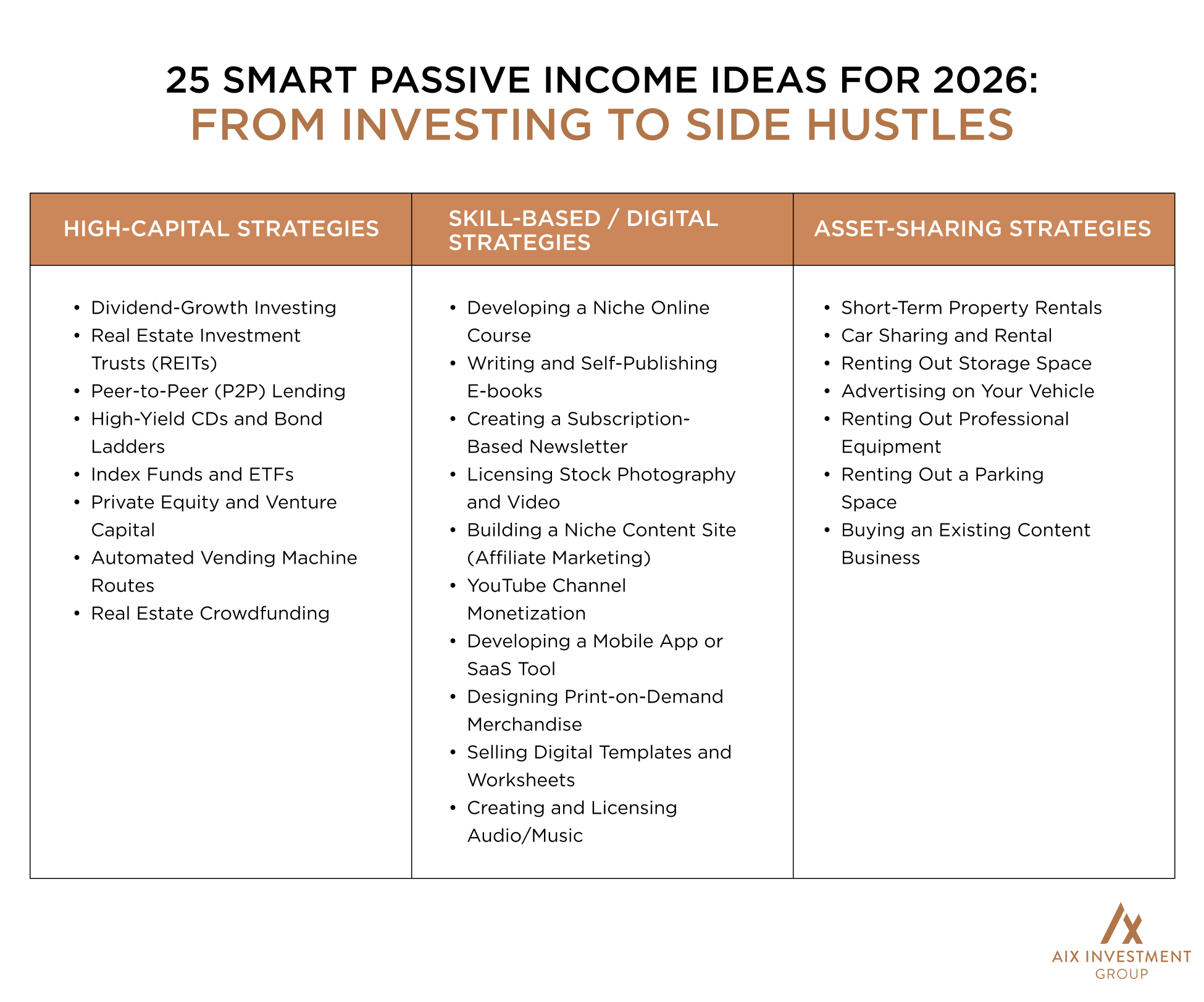
This strategy involves purchasing shares of dividend-paying companies that have increased their dividend payouts for at least 25 consecutive years. As a shareholder, you receive a portion of the company’s earnings, usually paid out quarterly.
REITs are corporations that own and manage portfolios of income-producing real estate. By buying shares on the stock market, you may receive dividends from the rent collected by the trust without having to manage properties yourself. Recent research from J.P. Morgan indicates a rise in FFO (Funds From Operations) growth trends for REITs, which may support investor interest in the sector.
Using digital platforms, investors can act as direct lenders. Investors provide small loans to individuals or small businesses in exchange for interest payments, effectively bypassing traditional banks.
A ladder involves purchasing multiple CDs or bonds with staggered maturity dates. As each one matures, you may choose to reinvest it at the current market rate or use the cash, which can help provide more consistent liquidity over time, while allowing investors to lock in relatively elevated rates compared to recent lows.
Instead of picking individual stocks, you invest in a fund that tracks a specific market index (like the S&P 500). This provides broad exposure to the economy’s growth and may generate steady dividend income over time.
This involves investing directly in private companies or startups. Investors provide capital to support growth in exchange for an equity stake, with returns often realised during events such as acquisitions or initial public offerings (IPOs).
Investors purchase machines that dispense snacks, drinks, and packaged goods (the most common model, although machines offering tech products or healthier meals also exist) and place them in high-traffic locations. Income is generated from the margin between the wholesale cost of the product and the retail price paid by the customer.
Investors pool small amounts of capital (sometimes as low as $500) to fund specific large-scale development projects through online platforms.These projects may include residential or commercial developments, with investors earning returns based on rental income, interest, or project appreciation.
Creators package their expertise into a series of videos and worksheets. Once hosted on a platform like Teachable, it can be sold continuously with limited ongoing involvement. Short-form or mini-courses (1 to 3 hours) are often favored by learners for their accessibility and associated with higher conversion rates compared to longer-form content.
Using Amazon Kindle Direct Publishing( KDP), authors can bypass traditional publishers, publish and distribute their work globally. You write the content once, and it can generate royalties every time a copy is purchased or downloaded.

Using platforms like Substack, creators can share specialised insights with a defined audience. Readers pay a monthly fee for access, creating a recurring revenue model.
Creators upload your creative portfolio of photos and video content to stock agencies. When businesses need imagery for their campaigns, they pay a licensing fee to use this content. Demand has been growing for versatile digital assets, including short-form video clips and motion graphics, particularly those that can be easily adapted for modern digital and AI-assisted workflows.
A niche content site can be developed around a specific category. Revenue is generated when a reader clicks your link and makes a purchase through partner platforms such as Amazon Associates or other affiliate networks.
Content creators produce evergreen video content. Once YouTube’s partner requirements are met, a share of ad revenue may be generated from views.
Software as a Service (SaaS) involves creating a tool that solves a recurring problem (e.g., an AI-powered project management tool). Users pay a monthly subscription to use the software.
Designs are uploaded to platforms such as Printful. When a customer orders a shirt, the provider handles printing and shipping, allowing the creator to earn a profit margin on each sale without holding inventory.
Digital tools such as Notion layouts, Excel financial models, or pitch deck templates can be created and sold on marketplaces like Etsy or Gumroad.
Musicians can produce jingles, ambient loops, or sound effects and license them to filmmakers and podcasters through stock audio sites.

Property owners may rent out a room or house on Airbnb. In 2026, data shows mid-term rentals (30+ days) are becoming increasingly popular, often associated with more stable occupancy and lower turnover.
Platforms like Turo allow vehicle owners to list their cars for rent when they are not in use.
Unused space such as garages, basements, or attics can be rented out through platforms like Neighbor.
Companies pay to apply branding to your car. Compensation is typically based on daily mileage and geographic location.
From cinema cameras to heavy-duty power tools, owners of specialised equipment may rent it out via peer-to-peer marketplaces.
In major metropolitan hubs, a dedicated parking spot is often in limited supply. Parking spaces may be rented out on a monthly or daily basis.
This involves acquiring an established blog, newsletter, or YouTube channel that is already profitable.

If you are looking for a roadmap on how to earn passive income, the following framework may help guide your approach:
While self-directed strategies can provide a foundation for building income, some investors choose to work with professional financial advisors when managing larger or more complex financial positions and identifying investment opportunities that may not be easily accessible individually, including areas such as Forex, commodities, digital assets and properties.
AIX Investment Group provides advisory services focused on supporting clients in navigating the complexities of large-scale capital growth and diversified investment strategies.
For those looking to scale their passive income beyond a secondary stream, working with an experienced advisory firm can help ensure portfolios are built with a focus on transparency, innovation, and long-term planning.
In 2026, compliance typically involves obtaining explicit opt-in consent for digital marketing activities. If income is generated through newsletters or SaaS, it is generally expected to maintain clear, verifiable bilingual (Arabic/English) consent log and ensure appropriate data protection measures, including safeguards for cross-border data transfers. Non-compliance may result in administrative fines, which can affect overall profitability.
In some cases, high-quality liquid assets like REITs, equities, or professional bonds can be leveraged for Lombard loans. This may allow access to a line of credit against a portfolio’s value (typically 50% to 80%) without selling holdings. It can be used as a way to access liquidity, depending on individual circumstances and lender terms.
For UAE residents, passive income from personal bank interest, dividends, or income from personal real estate is generally exempt from the 9% Corporate Tax. However, if these activities are conducted through a commercial license or exceed specific turnover thresholds for business-like activity, individuals may be required to register for Corporate tax with the Federal Tax Authority and comply with applicable regulations.
This process often involves reducing direct involvement over time by systemising operations. Once an asset (such as an online course) becomes profitable, some individuals choose to reinvest into operational support, such as automation tools, agency partners or virtual assistants. This can help shift involvement from active management to a more oversight-focused role, although some ongoing management is usually still required.
During inflationary periods in 2026, investors may rebalance their passive portfolios to reduce exposure to assets that are sensitive to inflation and increase allocation to assets that tend to perform better in rising price environments. These may include real estate, inflation-linked bonds, equities with pricing power, and commodities or commodity-linked instruments depending on individual goals and risk tolerance.
Overview