

Insight

The integration of non-traditional financial assets has become a vital component of modern portfolio construction. As global markets evolve and traditional asset classes experience greater volatility or lower yields, institutional and high-net-worth investors are increasingly exploring alternative strategies to enhance diversification and pursue more resilient return profiles.
Success in this field requires a distinct skill set, particularly in deep valuation and long-term capital commitment. Beyond asset selection, alternative investment management involves navigating complex risk profiles and illiquid structures to capture returns that are typically less correlated with traditional market benchmarks.
Alternative investments encompass assets that fall outside traditional categories such as equities, fixed income, and cash equivalents, including private credit, gold, and timberland. Characterized by their non-traditional structures, these assets typically operate outside public markets, are subject to different regulatory frameworks than mutual funds, and often require specialised expertise for rigorous due diligence.
Their primary value lies in diversification and lower correlation. When traditional markets fall, alternative investments often react independently, acting as a critical hedge against broader economic risks. By investing in assets that don’t move in sync with the major equity indices or government treasuries, asset managers can better balance the risk-return profile and build more stable, diversified portfolios.
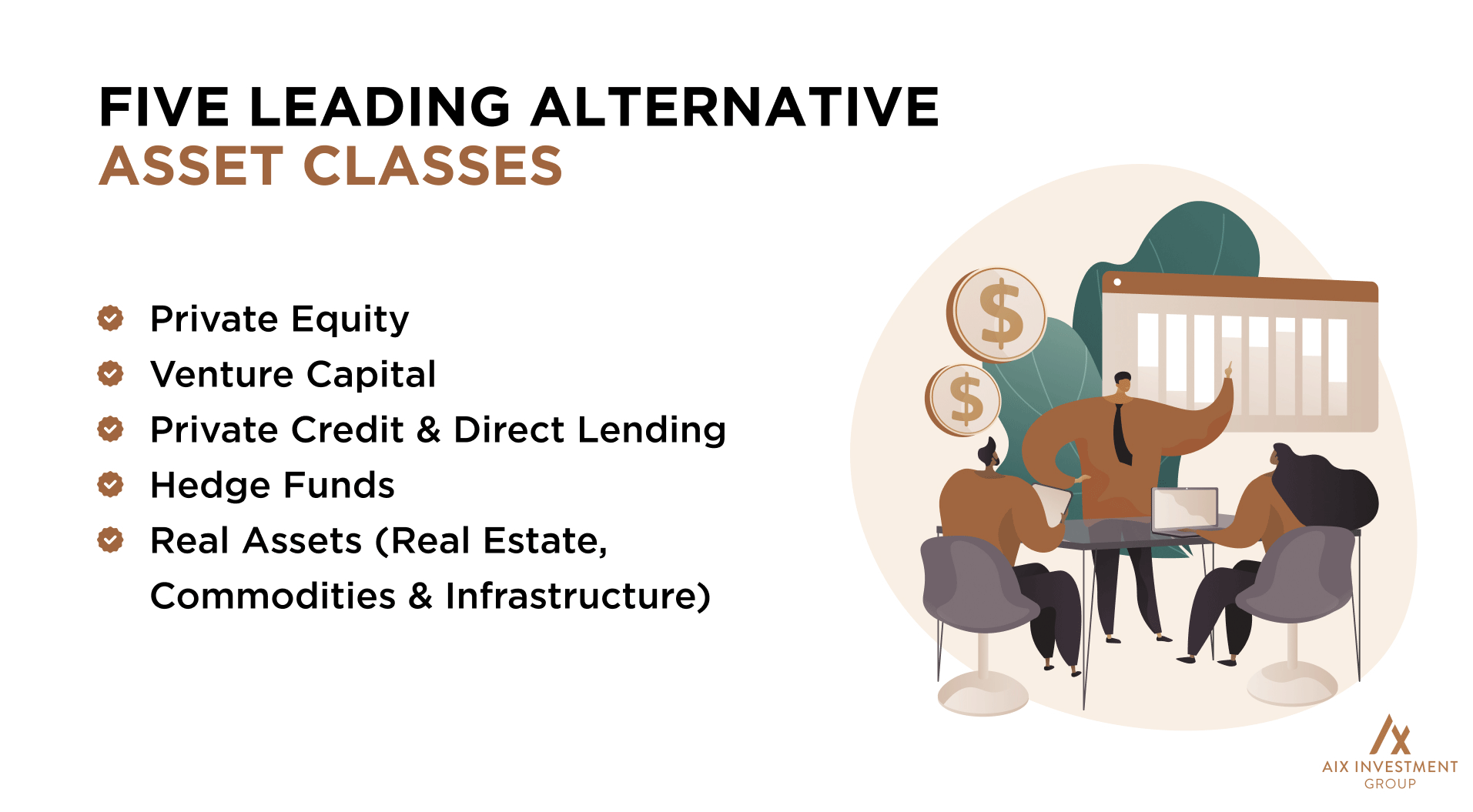
To understand investment strategies, it is helpful to first categorise the assets involved. The landscape is broad, ranging from tangible physical assets to complex financial derivatives that require sophisticated oversight.
This specific asset class involves the direct investment of capital into private companies or the buyout of public companies to take them private. Investment professionals in this space focus heavily on value creation.
Unlike passive public market investing, managers actively engage in governance through board participation, management restructuring, and operational improvements to enhance enterprise value over a 5–10 year horizon.
Venture capital is a subset of private equity that focuses specifically on high-growth startups and early-stage companies characterised by higher risk but significant upside potential.
This has grown significantly in recent years. It involves non-bank institutions providing loans directly to companies. Managers in this space focus on the middle market businesses that are too large for local retail banks but too small for the public high-yield bond market.
Strategies here emphasise rigorous credit underwriting and capital preservation. Because these loans are privately structured and often customised, they typically command higher interest rates than public bonds, providing investors with consistent income streams.
These are pooled investment vehicles that employ diverse and active investment strategies to generate active returns. Unlike mutual funds, these managers have the flexibility to use leverage, short positions, and trade derivatives.
Investment approaches vary widely, ranging from macro funds that focus on global economic trends to quantitative funds that use statistical and algorithmic models to exploit pricing inefficiencies across markets.
These physical investments have intrinsic value and can serve as a hedge against inflation. In the realm of real estate, investment management includes commercial properties, residential developments, and real estate investment trusts.
Commodities include natural resources like oil, natural gas, precious metals, and agricultural products. Infrastructure investing involves essential assets and services like toll roads, bridges, utilities, and renewable energy grids. These assets are often valued for their ability to respond positively to changes in the cost of living and replacement costs.
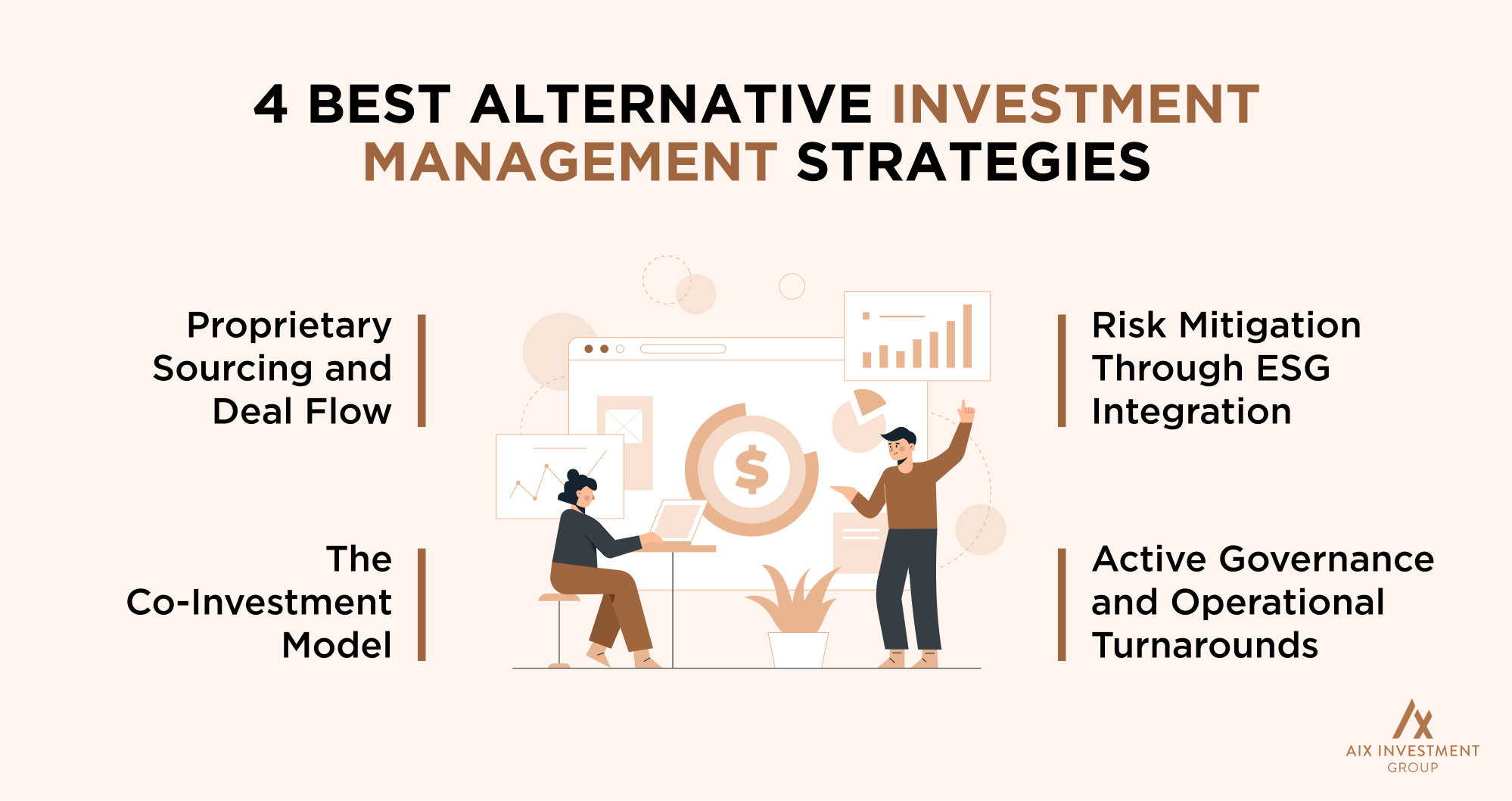
Managing these assets often involves moving beyond the buy-and-hold philosophy common in retail investing. Instead, managers employ specific strategies to identify opportunities in less efficient markets.
A key strategy in this field is the ability to find off-market deals. Institutional managers leverage their extensive industry networks and relationships to identify investment opportunities before they reach the general public. By avoiding auctions or public bidding processes, managers may be able to negotiate more favorable entry prices and terms, which can support overall returns. This sourcing advantage is often what separates top-tier managers from others in the industry.
Sophisticated managers often invest their own capital alongside the capital of their clients. This serves two purposes.
This alignment is generally valued by institutional partners, particularly where shared exposure to downside risk is considered important.
Modern alternative investment management increasingly incorporates Environmental, Social, and Governance (ESG) criteria. This is not merely for ethical reasons but can form an important part of a risk management framework.
For instance, in the private credit market, managers may assess whether a borrower’s environmental liabilities or governance weaknesses could lead to financial distress and weaken loan repayment capacity. By integrating these factors into the underwriting process, managers can identify long-term sustainability related risks that traditional financial analysis may overlook.
In private equity, value creation often depends on active ownership and operational involvement rather than passive market appreciation alone. Managers do not simply wait for the market to recognise a company’s value; they may take steps to enhance it.
This may involve streamlining supply chains, expanding into new geographic markets, or merging the company with other portfolio firms to achieve economies of scale. This hands-on approach is intended to support value creation, regardless of broader market conditions.

The alternative investment manager acts as both a fiduciary and a specialist. Their role involves a rigorous cycle of fundraising, sourcing, due diligence, asset management, and eventually, investment exit strategies.
One of the most intensive phases is due diligence. This involves analysing financial records, interviewing management teams, assessing the competitive landscape, and performing legal and operational checks. Because alternative assets are generally less transparent than public ones, the manager’s ability to uncover hidden risks is critical.
Furthermore, unlike a stock that has a ticker price updated every second, an alternative asset is typically valued using complex modelling. Managers commonly rely on methodologies such as discounted cash flow analysis or comparable company analysis to determine what an asset is estimated to be worth.
Another significant challenge is the management of illiquidity. Investors in private equity or real estate funds often have their capital locked up for several years.
As a result, managers must carefully structure these investment vehicles to balance liquidity needs with the time required for assets to mature and grow in value, before reaching an appropriate exit point. Managing the J-Curve effect, where initial costs and investments lead to early losses before the long-term gains materialise, is a specialised aspect of this field.
The shift toward these assets is driven by the limitations of the traditional portfolio consisting solely of equities and fixed income securities. In an era of high equity valuations and fluctuating interest rates, traditional portfolios may not always meet the long-term funding requirements of pension funds or the wealth preservation goals of families.
Historical data suggests that certain alternative classes, particularly private equity, have at times outperformed public markets over long periods. Additionally, because these assets are driven by different economic factors (such as cash flows generated by a specific infrastructure project versus the performance of the broader market), they can contribute to a more balanced overall portfolio experience. In a world where government bonds may offer low real yields, private credit and real estate may provide more consistent cash flow through interest payments and rent.
Furthermore, alternative investment management can offer a greater degree of customisation. Unlike a standardised mutual fund, an alternative mandate can be tailored to the specific tax situation, risk appetite, or ethical requirements of a large investor. This bespoke nature is particularly important for sovereign wealth funds, pension plans and large endowments that have multi-generational investment horizons and require a partnership approach rather than standard retail investment solutions.

While the potential benefits of alternative investments can be significant, the asset class also presents a range of challenges and operational complexities. Higher fee structures are common, often following the traditional 2 and 20 model consisting of a management fee and a performance fee on profits.
Although alternative investments are generally subject to different regulatory frameworks than public markets, the regulatory environment continues to evolve. Managers often need to navigate complex tax laws, international trade regulations, and changing reporting standards across multiple jurisdictions. Finally, many strategies require a specific legal status, meaning they are typically available to those with significant net worth or institutional scale.
The complexity of tax reporting is another hurdle. Investors in these vehicles often receive Schedule K-1 forms rather than standard Form 1099s, which can delay tax filings and require specialised accounting support. Managers also handle capital calls, where investors may be required to provide funds on short notice as investment opportunities arise. This structure requires careful liquidity planning on the part of both managers and investors.
Success in alternative investment management often depends on a combination of patience, specialised analytical skill, and the ability to identify unique opportunities in an increasingly crowded marketplace. For the informed investor, understanding this discipline can support the development of a resilient and diversified portfolio that is better positioned to navigate changing economic conditions.
In this environment, leading financial services firms such as AIX play an important role in connecting investors with relevant investment opportunities across both alternative and traditional markets. Through tailored investment guidance and access to a broad range of strategies, AIX helps investors explore opportunities that align with their individual objectives and risk profiles.
This refers to committed but unallocated capital held by investment funds. While it shows a firm has the capacity to make acquisitions, high levels of dry powder in the industry may contribute to increased competition for deals and upward pressure on asset prices, particularly for high-quality opportunities.
The J-Curve describes a period where a fund’s internal rate of return is negative in the early years due to capital deployment, setup costs and management fees. Returns may increase over time as the underlying assets mature and are eventually sold for a profit.
This is the additional return investors expect for locking their money away in assets that cannot be sold instantly. Because a private loan cannot be traded as easily as a public stock, investors demand higher potential returns to compensate for reduced flexibility.
If an investor needs liquidity before a private fund’s 10-year term ends, they may sell their stake on the secondary market. These transactions allow new investors to gain exposure to more established portfolios, with pricing that may trade at a discount or premium, depending on market conditions.
The SEC has proposed revisions to the asset thresholds defining smaller investment advisers. This change is intended to refine regulatory classification and potentially reduce the compliance burdens on mid-sized firms, allowing them to allocate more resources to investment management and research activities rather than regulatory reporting.
Overview