
The UAE does not impose tax on most types of personal income. It is one of the key reasons that attracts expats and FDIs. However, many other countries still continue to tax their residents on worldwide gains and income sources. This tax landscape makes expats earning business profits or investment income subject to double taxation.
With the UAE now imposing corporate taxes under certain conditions, the likelihood of businesses and self-employed individuals being taxed has increased. To mitigate double taxation risks, the UAE has entered into Double Taxation Agreements (DTAs) with more than 100 countries. These treaties allocate taxing rights between jurisdictions and may provide exemptions, reduced tax rates, or foreign tax credits, depending on the income type and treaty terms.
The dual taxation in the UAE specifies which jurisdiction has the primary right to tax income, supporting expats to avoid being taxed on the same earnings or income twice.
Not all countries are covered under the dual tax treaty in the UAE. This is why it is vital for expats living in the UAE to verify whether their country is listed in the treaty. This guide provides a simple breakdown of dual taxation in the UAE, how it works, the countries covered by the agreement, and the benefits for partner countries.
A double taxation agreement (DTA) is a treaty between two countries that prevents individuals and businesses from being taxed twice on the same income, i.e., once in the country where it’s earned, and again in the taxpayer’s home country. It primarily decides which country or jurisdiction has the right to impose tax and outlines the rates applicable to both active and passive income.
As the UAE does not impose personal income tax on individuals, the income from employment, rent, capital gains, or inheritance is not subject to tax under the domestic law. As a result, most income earned by individuals and expats in the UAE is not taxed, even though the DTA grants the UAE the right to tax it.
DTAs are still important in case of future changes to the UAE tax law. It is also crucial for protecting business income against double taxation, which can be subject to corporate tax.
Effective June 01, 2023, the UAE imposes a 9% on corporate taxable profits exceeding AED 375,000. This tax policy applies to both resident companies and foreign businesses operating through a permanent establishment (PE) in the UAE, such as branches of overseas corporations or foreign banks.
The context of dual taxation varies between different countries. In general, most DTAs include the following information:
The above points reflect the general information included in the double taxation treaties, regardless of the countries involved. The DTAs concluded with the UAE incorporate the following information:
Navigating the framework of dual taxation in the UAE requires expats and foreign businesses to understand their full implications to claim all eligible treaty reliefs and optimise their global tax position.
Depending on the outlined terms of the double taxation agreement, an individual can be eligible for tax relief through one or more of the following ways:
Note: Withholding tax (WHT) is generally deducted from income sources, such as interest, royalties, and dividends, to ensure tax collection on cross-border payments.
The UAE applies a 0% WHT rate, whereas other jurisdictions, such as Portugal and Switzerland, impose a WHT on outbound payments ,often subject to treaty limitations.
Where a UAE-based company is subject to UAE corporate tax on such income, any foreign withholding tax paid may be credited against the UAE corporate tax liability, subject to the applicable double taxation agreement and UAE tax law, thereby preventing double taxation.
To date, the UAE has signed and implemented Double Taxation Agreements (DTAs) with over 140 countries across Asia, Europe, Africa, and the Americas.
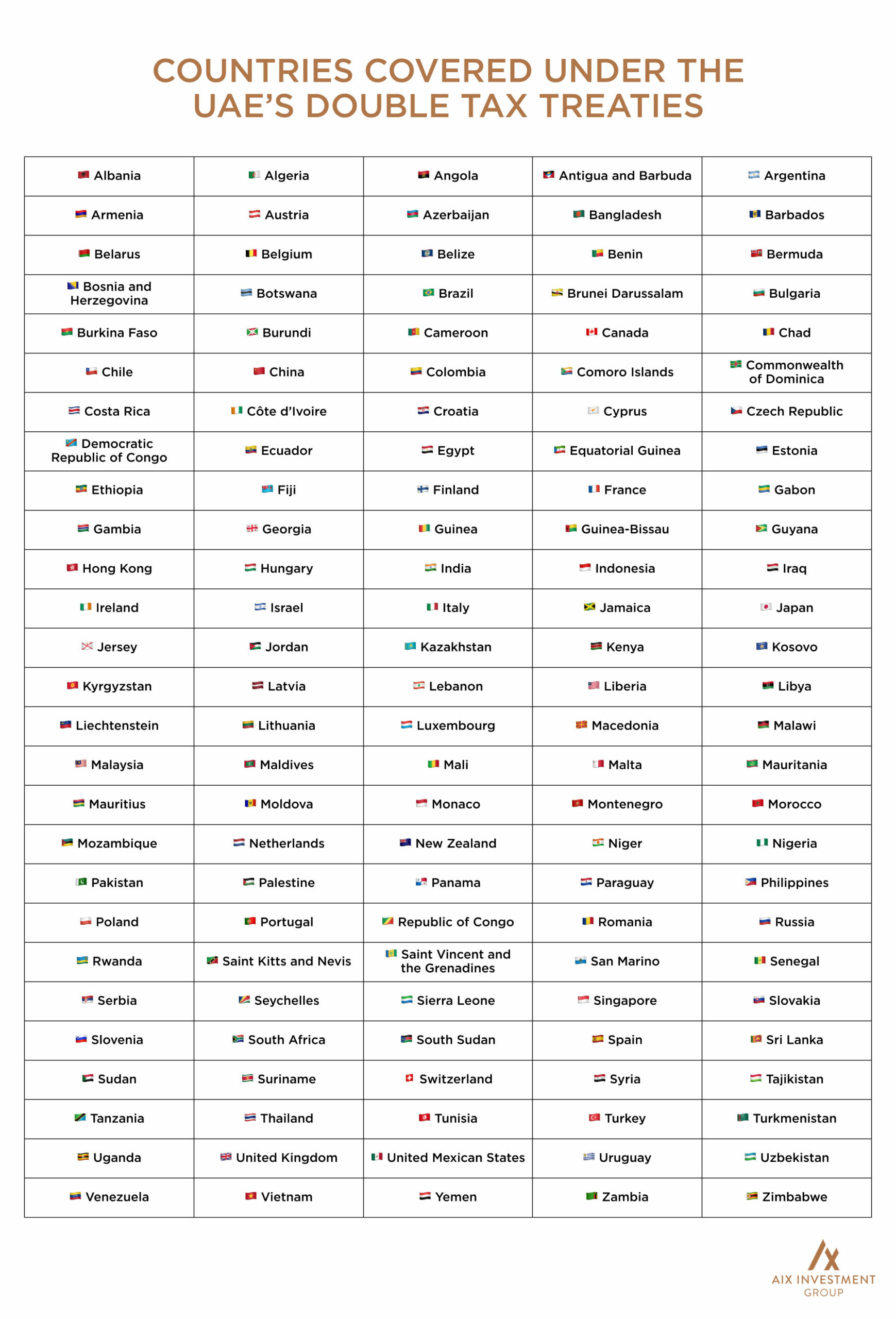
Yes. The double taxation agreement in the UAE varies depending on the terms negotiated with each country. The differences generally arise from the following terms:
In addition, each country applies specific rules based on an individual’s or entity’s tax residency as defined by each country. For example, in the UK, tax residents are liable on their worldwide income. In contrast, non-residents are only taxed on their income generated within the UK.
DTAs generally come into effect to prevent double taxation when both the UAE and the treaty partner country tax the same category of income, such as business profits and investment income. Understanding the specific terms of each treaty is important for expats and businesses to maximise treaty benefits and manage their global tax obligations efficiently.
DTAs are updated regularly to reflect changes in accordance with international tax policies, economic growth, and evolving political or diplomatic relationships between the two jurisdictions.
Recently, the UAE has made several important changes to its treaty network, including:
The DTAs in the UAE provides many benefits for partner countries, of which the most notable ones are:
One of the primary benefits of the DTA for partner countries is the ability to avoid paying tax on the same income twice. This makes cross-border business more financially feasible and practical. It also helps the UAE attract more FDI.
Investors in the UAE from partner countries can freely do business and explore market opportunities with confidence, as they know their profits or gains will not be subject to excessive taxation back home.
By easing the tax burden for businesses between the two countries, DTAs encourage stronger trade relationships.
Provisions within a Double Taxation Agreement (DTA) promote transparency and cooperation between countries’ tax authorities, reducing tax evasion and fraud.
Double taxation agreement with the UAE provides a structured set of rules and policies that reduce disputes and misunderstandings. This enables businesses to determine which country has the right to tax specific sources of income.
In general, partner countries under the UAE’s DTA treaty benefit because their citizens and companies can engage in UAE businesses and investments with reduced tax complications, greater clarity, and better profitability.
As one of the renowned financial advisors and consultants in the Middle East, AIX specializes in simplifying legal and regulatory compliance for businesses, investors, and personal financial management.
Our financial consultants can provide expert cross-border tax planning for expats living in the UAE. We will help you determine the tax residency status, apply for relevant treaty relief, and support you in efficiently structuring your global income and investments.
For more details, get in touch at +971 4 546 0000 or schedule a meeting.
Personal income in the UAE is generally tax-free for residents, provided you have a UAE residence visa and do not maintain official residency elsewhere.
No, the UAE does not tax foreign income for individuals. However, certain corporate income may be subject to UAE corporate tax.
You need to live in the UAE for more than 183 days to be considered eligible for an international tax residency, which is used for proving tax residency internationally.
No, expats are not subject to personal income tax on their earnings. Indirect taxes such as VAT may still apply.
If an expat resident lives outside the UAE for more than 180 days, their residency visa will be automatically nullified. In this case, they will have to apply for a new entry permit to enter the UAE again.
There is currently no double tax treaty between the UAE and the US.
Yes, the US taxes its citizens on worldwide income, so US citizens living in the UAE may still have US tax obligations.
Overview